
Active Directory minimization case studies
Reduce Your Dependence on Active Directory with Real-World Examples: Cloud-First Strategies, Case Studies, and Practical Tips to Modernize Identities and Devices.

Reducing Dependence on On-Prem Active Directory doesn’t have to mean “Full Cloud or Nothing”. It’s more useful to think in terms of AD minimization: gradually moving identities and device management to cloud platforms (Microsoft Entra + Intune) where it makes sense, while keeping on-prem only where it’s truly needed.
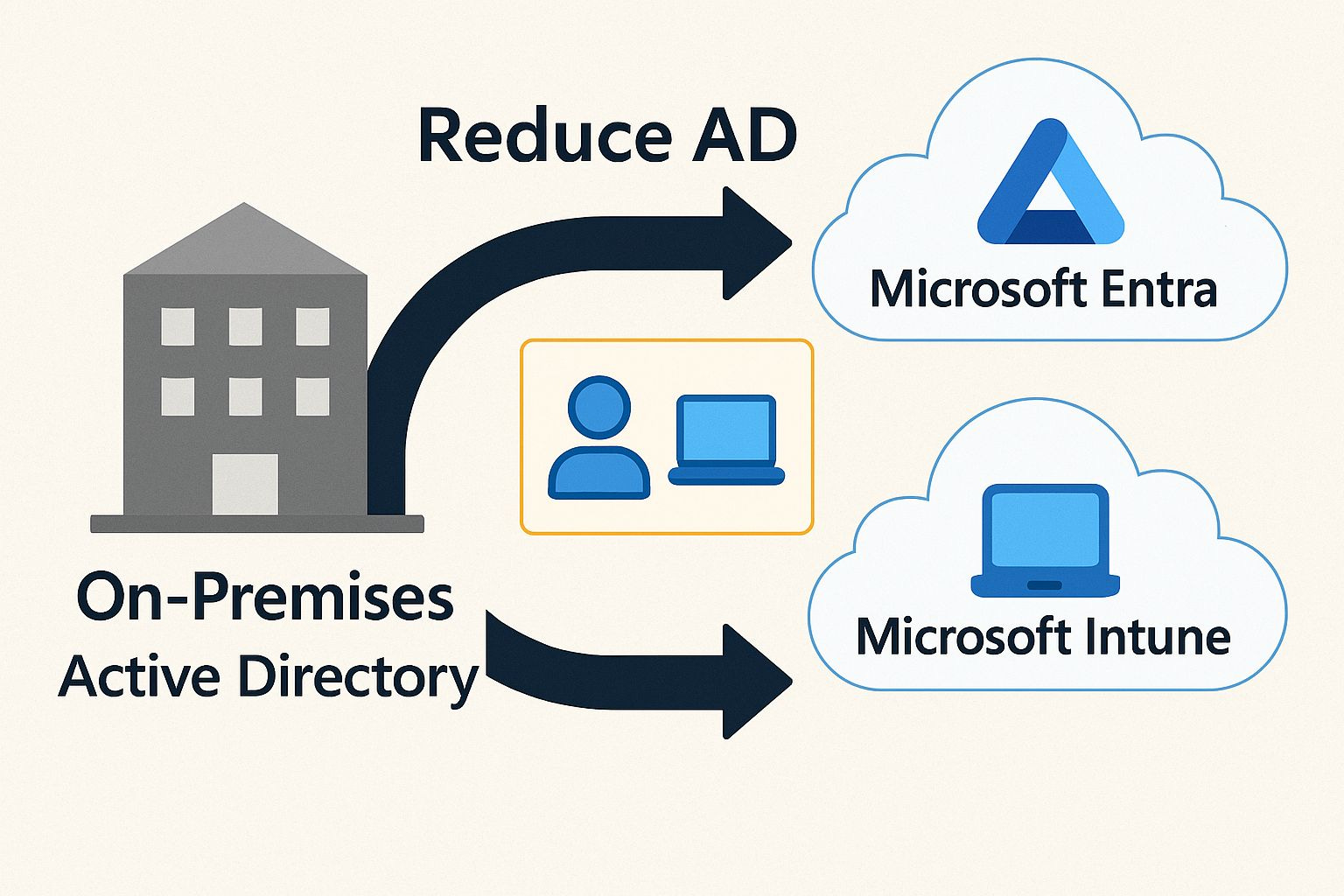
What Does “Reducing AD” Mean?
In the Microsoft document (you’ll find the link at the end of the article), the concept refers to reducing reliance on traditional AD services (domain join, GPO, infrastructure, and operational overhead) by shifting identity and device management toward the cloud.
The stated benefits are clear: lower infrastructure costs, modern security (e.g., Conditional Access), improved user experience, and simpler, centralized management.
Do You Have to Go Full Cloud?
No: case studies show different paths, and that’s the interesting part.
Practical example: you can start with devices (provisioning and management) without “turning off AD tomorrow morning,” and even that significantly reduces domain dependency.
3 Practical Insights from Case Studies
Chugai Pharmaceutical: transition from domain-joined devices to cloud-managed endpoints, using Windows Autopilot for “cloud-first” provisioning.
NTT Communications: evolution from hybrid to “100% cloud” device management with Microsoft Intune, reducing AD dependencies and simplifying operations.
We Are Era: on-prem AD decommissioning with a focus on modern authentication and Zero Trust principles, including integration between cloud identities and on-prem resources where necessary.
Want to Learn More?
Here’s the full article 👉🏻 Active Directory Minimization Case Studies